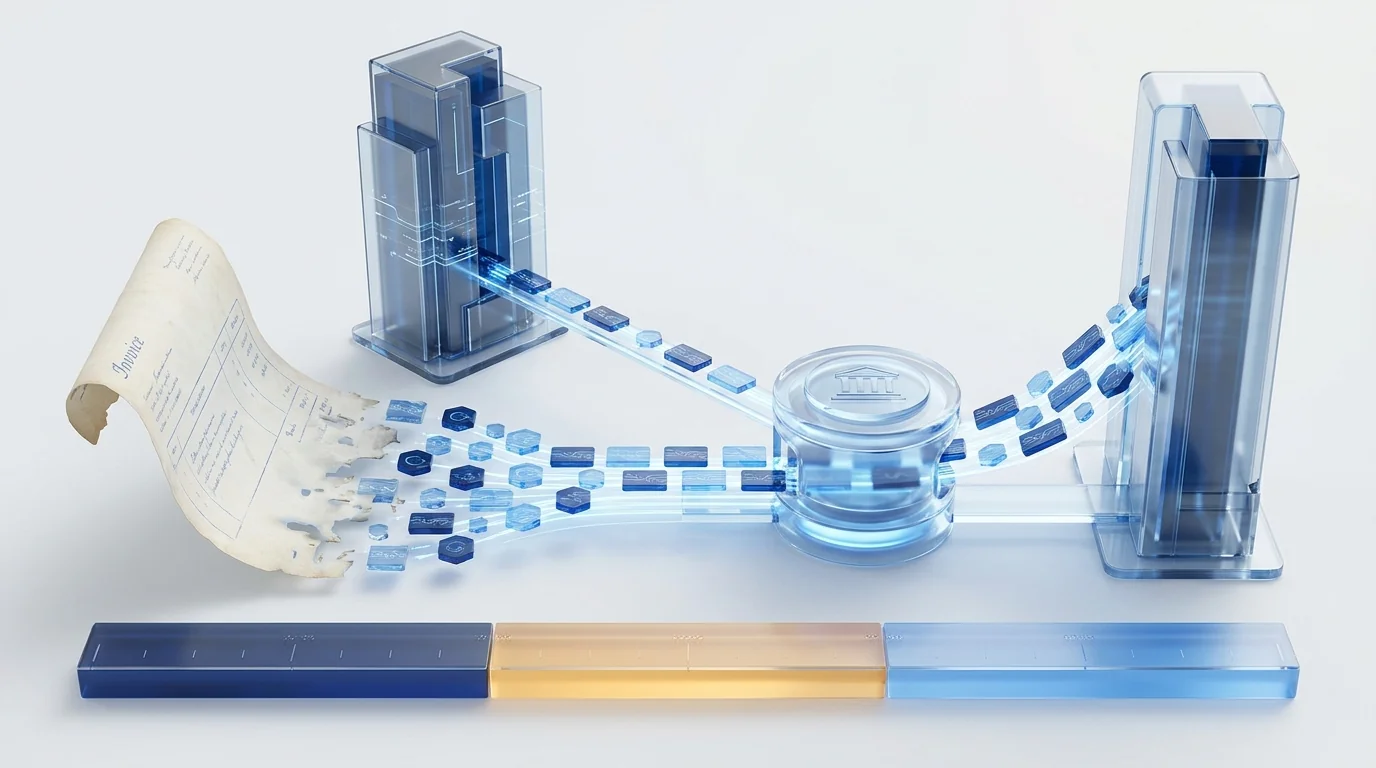
Electronic invoicing will be mandatory for transactions between businesses and professionals in Spain: 12 months after the ministerial order is approved for those invoicing over €8 million a year, and 24 months for everyone else — expected between late 2027 and 2028. It is regulated by Royal Decree 238/2026, which also requires reporting the acceptance, rejection and actual payment of every invoice.
What changes: from PDF by email to the structured invoice
The obligation stems from Article 12 of Law 18/2022 on business creation and growth (the Crea y Crece Law), which back in 2022 announced mandatory e-invoicing for all B2B transactions in Spain. What was missing was the regulation saying how. That regulation is Royal Decree 238/2026, of 25 March, published in the BOE on 31 March 2026, and it defines three things:
- A mixed platform system: you will be able to invoice through private exchange platforms, through the public platform run by the AEAT, or both. Private platforms are required to interconnect with one another: your customer won't need to be on the same platform as you.
- Structured formats, not images: the invoice stops being a document to read (PDF, paper) and becomes a machine-processable data file — Facturae, UBL, CII or EDIFACT, all built on the European EN 16931 standard.
- Payment traceability: the recipient will have to report the invoice's statuses — acceptance or rejection and actual payment with its date — so the government can measure real payment periods and tackle late payment.
The key nuance: this is not (just) a format change. It is the mandatory digitisation of the entire invoice lifecycle — issuing, receiving, internal approval, payment and reporting — which is why it affects both the ERP and the finance processes built around it.
The real timeline: a clock that hasn't started yet
RD 238/2026 contains no fixed dates. The clock starts when the ministerial order implementing the public invoicing platform is approved — its draft is already circulating, with approval expected in the course of 2026. From that moment:
| Who | Obligation | Deadline from the ministerial order |
|---|---|---|
| Companies and professionals with turnover above €8 M | Issue and receive B2B electronic invoices | 12 months (forecast: late 2027) |
| All other companies and self-employed workers | Issue and receive B2B electronic invoices | 24 months (forecast: 2028) |
| SMEs and self-employed workers | Additionally report payment statuses of received invoices | 36 months, after an additional transition period |
Sounds far away? The calendar is deceptive. If you issue or receive invoices from large customers or suppliers, their 12-month obligation drags you along in practice: once your main customer only accepts structured invoices, everyone else's legal date becomes irrelevant. Spain's tax agency maintains an official information page with the state of the process.
B2B e-invoicing ≠ VERI*FACTU: two obligations, one project
It is the most repeated mix-up of 2026, and for good reason: they are two different sets of rules arriving almost at once and touching the same document. The difference, in short:
| VERI*FACTU | B2B e-invoicing (Crea y Crece) | |
|---|---|---|
| What it regulates | The invoicing software: tamper-proof records, chained hashes and submission to the AEAT (anti-fraud) | The exchange of the invoice between companies: structured format, platforms and statuses |
| Who it applies to | Anyone issuing invoices with software, even when invoicing consumers | Only transactions between businesses and professionals (B2B) |
| Dates | 1 January 2027 (companies) and 1 July 2027 (self-employed), already fixed | 12/24 months from the ministerial order (forecast 2027–2028) |
A typical company will have to comply with both. That is why it makes sense to approach them as a single project to digitise the invoicing cycle, not as two successive patches. If VERI*FACTU isn't on track yet, start with the complete VERI*FACTU guide and the VERI*FACTU vs SII comparison; for the systems side, how to adapt your ERP.
Formats, platforms and the public platform: the technical requirements
The essentials of the system the regulation draws up:
- Accepted formats: Facturae (the Spanish standard, in its current versions), UBL, CII and EDIFACT — all compliant with the European semantic standard EN 16931. PDF stops counting as a B2B invoice.
- Mandatory interconnection: private platforms must agree to deliver invoices to one another and convert them from one accepted format to another. You choose a platform for its service, not for where your customers are.
- The AEAT public platform: free issuing and receiving for anyone who doesn't contract a private platform, and a central repository that will receive a copy of every B2B invoice in Facturae format, including those issued through private platforms.
- Invoice statuses: commercial acceptance or rejection and actual payment with its date. It is the law's anti-late-payment lever — and the part that touches the most internal processes, because it requires knowing the status of every invoice at every moment.
The practical consequence: the challenge of 2027–2028 won't be "generating an XML" — any ERP or platform will do that. The challenge will be having the internal process (validation, approval, posting, payment, status reporting) digitised enough to respond on time and without manual work.
How Dokuflex solves it: the full workflow, not just the format
Dokuflex doesn't replace your ERP or your exchange platform: it automates the workflow the regulation assumes you already have. On the same BPM platform:
- AI-powered receiving and capture: incoming invoices — structured, or still PDF during the transition — are classified and their data extracted automatically, as we explain in the guide to intelligent document processing.
- Approval with SLAs: validation circuits by amount, cost centre or supplier, with alerts and escalation — the foundation for reporting acceptance or rejection on time.
- Statuses and traceability: every invoice sits in an audited flow that produces the milestones you will have to report (accepted, rejected, paid and when), integrated with your ERP through connectors and APIs.
- AEAT compliance already live: AEAT-approved AI invoice management and VERI*FACTU readiness cover today the part of the equation that already has fixed dates.
The advantage of solving it with BPM: when the ministerial order pins down the details, adjusting the process will be a visual change to the flow — not another custom build.
Checklist: what to get sorted in 2026
- Close VERI*FACTU first. Its dates (January and July 2027) are firm and condition the invoicing software you will use for everything else.
- Map your real invoice workflow. Who receives, who approves, who pays and where time gets lost. Invoice statuses will report themselves if the workflow is digitised; done by hand, they'll be a monthly burden.
- Ask your ERP and your platform about EN 16931. Which formats they will issue, how they will interconnect and how they will submit the Facturae copy to the AEAT repository.
- Digitise the inbound side, not just the outbound. You will receive electronic invoices before you are required to issue them; a receiving flow with automatic capture pays off from day one.
- Work out the return. Automating the workflow pays for itself before the obligation arrives — run the numbers with the ROI calculator, no email and in one minute.
- Watch the ministerial order. Its approval fixes the definitive timeline; from that day, the large companies' 12 months run for your entire chain of customers and suppliers.
Frequently asked questions
When will B2B e-invoicing become mandatory in Spain? +
Royal Decree 238/2026 sets no fixed dates: the clock starts when the ministerial order implementing the public invoicing platform is approved. From that moment, companies and professionals with an annual turnover above 8 million euros will have 12 months to issue electronic invoices in their B2B transactions, and all other companies and self-employed workers, 24 months. With the draft order already in the pipeline, the sector expects the obligations to take effect between late 2027 and 2028.
What is Royal Decree 238/2026? +
It is the regulation, published in Spain's Official State Gazette (BOE) on 31 March 2026, that implements Article 12 of Law 18/2022 (the Crea y Crece Law). It defines the architecture of the Spanish B2B e-invoicing system: a mixed model of interconnected private platforms plus a public platform run by the AEAT (Spain's tax agency) acting as a central repository, the accepted structured formats, and the obligation to report invoice statuses, including actual payment, to combat late payment.
Are B2B e-invoicing and VERI*FACTU the same thing? +
No, they are two separate obligations arriving almost at the same time. VERI*FACTU regulates invoicing software (tamper-proof records and submission to the AEAT, with dates already fixed: 1 January 2027 for companies and 1 July 2027 for the self-employed) and applies even if you invoice consumers. B2B e-invoicing under the Crea y Crece Law requires issuing and receiving invoices in a structured format between businesses and professionals, and reporting their statuses. A typical company will have to comply with both, so it makes sense to tackle them as a single project.
Which e-invoice formats are accepted? +
The system accepts the structured formats based on the European semantic standard EN 16931: Facturae (the Spanish standard, required on the public platform), UBL, CII and EDIFACT. Private exchange platforms are required to interconnect with one another and to be able to convert invoices between formats, so sender and recipient do not need to use the same platform or the same format. A PDF sent by email will no longer count as a valid invoice between companies once the obligation takes effect.
What role does the AEAT public platform play? +
The public e-invoicing platform, run by Spain's tax agency, will serve two functions: acting as a free issuing and receiving platform for anyone who prefers not to contract a private one — aimed mainly at low-volume SMEs and self-employed workers — and acting as a universal repository that will receive a copy of every B2B invoice. Companies using private platforms will have to submit a faithful copy of each invoice to that repository in Facturae format.
What are invoice statuses and what will have to be reported? +
Beyond issuing the invoice electronically, the recipient will have to report what happens to it: at minimum, commercial acceptance or rejection and actual payment with its date. It is the instrument the government intends to use to measure real payment periods and strengthen the fight against late payment, one of the declared goals of the Crea y Crece Law. In practice it requires your internal invoice approval and payment workflow to be digitised and able to report those milestones automatically.
Reach 2027 with your invoice workflow already digitised
Let's book a 60-minute session: we review your current invoice flow, mark what VERI*FACTU requires and what B2B e-invoicing will require, and you leave with a plan that covers both without duplicating work.