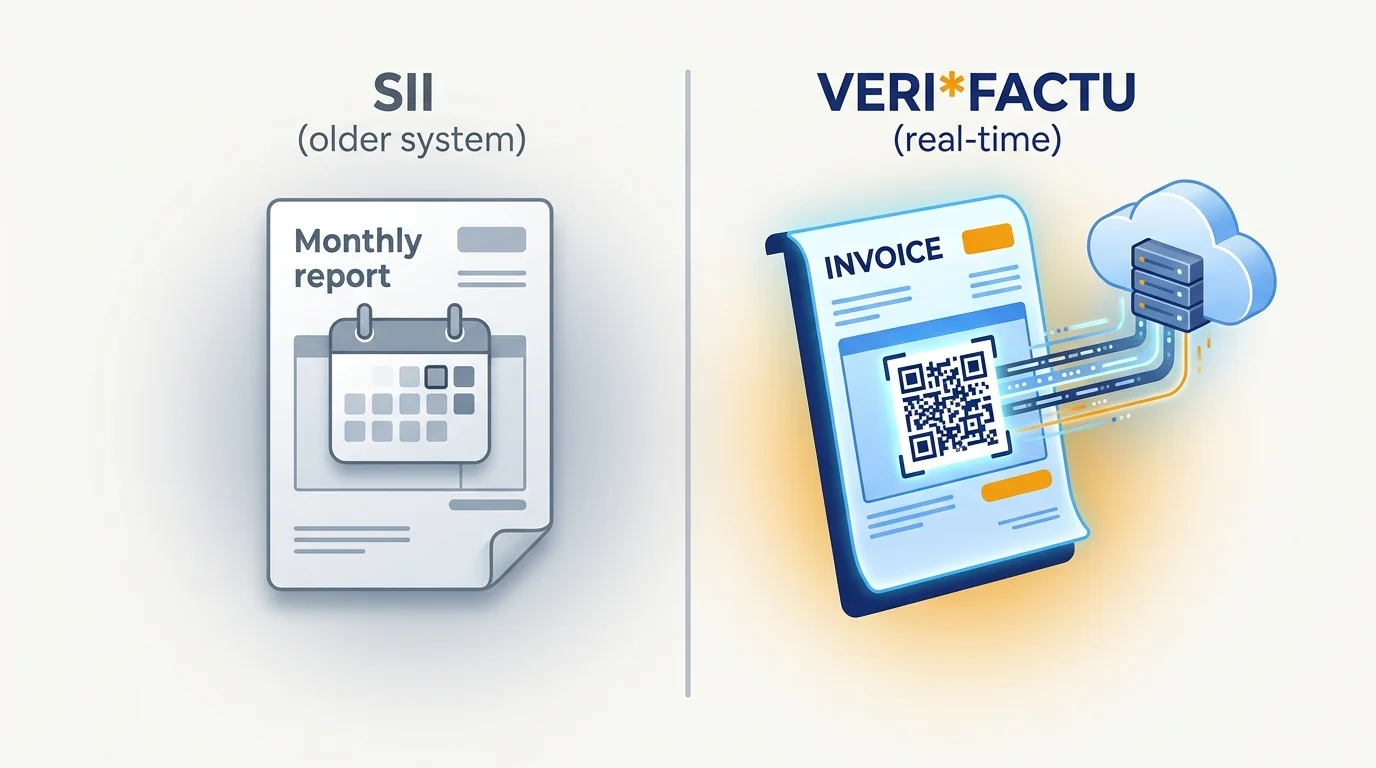
VERI*FACTU and SII share a general goal of tax control, but they do not work the same way or affect companies identically. Confusing the two models can lead to wrong technical decisions, poorly planned integrations and a more expensive deployment than needed.
In this SEO-optimized version we have reorganized the information so you can quickly identify the impact of VERI*FACTU on operations, the decisions you need to make, and how a platform like Dokuflex can help you move from theory to execution.
Key points to review from the start
The first step is understanding which system applies to your company and what type of traceability each one requires.
- VERI*FACTU focuses on billing software and the integrity of the record.
- SII follows a different logic of immediate information supply to the AEAT.
- Not every company obliged by one is obliged by the other in the same terms.
How to bring it into operations without friction
From an operational standpoint, the difference changes how ERP, billing, digital signature and archiving are integrated.
- Review how records are generated and whether your software preserves integrity and sequence.
- Assess whether you need to adapt the ERP, the tax connector or both components.
- Ensure evidence, audit and control over corrections and cancellations.
Where Dokuflex fits in
Dokuflex helps build a process and control layer over billing so you do not depend on disconnected solutions.
- Better visibility over the full flow from issuance to archive.
- Lower non-compliance risk from integration or traceability errors.
- Easier rule adaptation if the regulatory framework changes.
Turn this need into a measurable process
Dokuflex combines BPM Low-Code, document management, digital signature, integrations and AI to help you automate processes with control, traceability and the ability to evolve.
Frequently asked questions
Does VERI*FACTU replace SII
Not necessarily. They are different models with different operational purposes, although both seek to strengthen tax control.
Can the same environment cover both scenarios
Yes, as long as the architecture provides traceable records, ERP integration and the ability to adapt rules and evidence to the applicable obligation.
Related articles
View all
VERI*FACTU technical requirements
Summary of the technical requirements that billing software must meet to comply with VERI*FACTU without leaving integrity or audit gaps.

VERI*FACTU software compatible with AEAT
What software compatible with VERI*FACTU must deliver in practice to meet registration, evidence and integration requirements.

How to adapt your ERP to VERI*FACTU
Steps to adapt the ERP to VERI*FACTU without breaking daily operations or losing visibility over records, approvals and evidence.