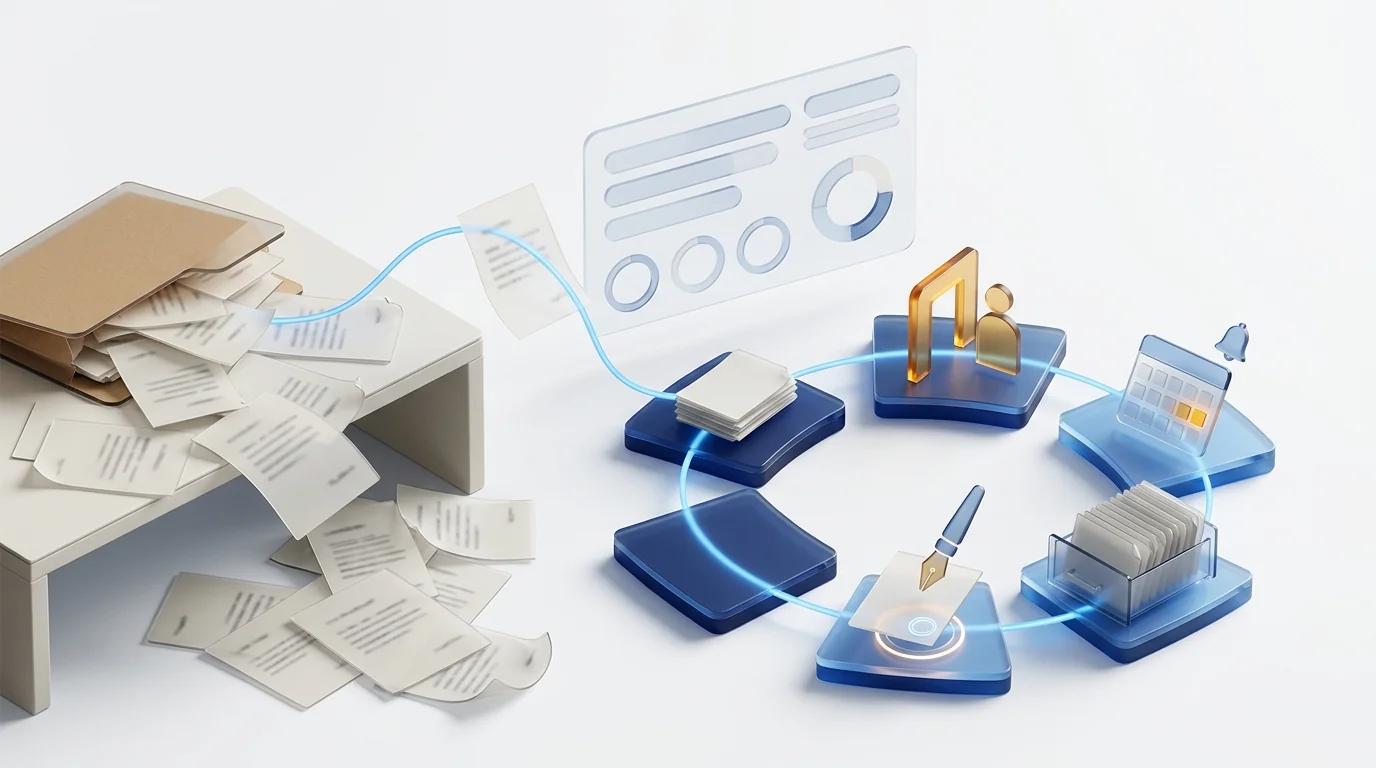
Contract lifecycle management (CLM) is the control of a contract across its six stages: request, drafting, approval, signature, filing with obligations, and renewal or expiry. According to World Commerce & Contracting, managing them poorly costs companies around 9% of their bottom line. Most of it is lost in the last two stages: obligations nobody tracks and renewals nobody decides.
Where contracts get lost today: the five value leaks
Contracts are not lost at the moment of signing; they are lost afterwards. Signing is the only instant when everyone is paying attention to the document. From then on it goes into a shared folder, an email or a drawer, and the contract keeps producing effects without anyone looking at it. These are the most common leaks, in the order they usually appear:
| Leak | How it shows up | What it costs |
|---|---|---|
| Uncontrolled versions | "Contract_v3_final_FINAL.docx" and nobody knows which one was signed. The version sent to the customer is not the one management approved. | Clauses the company never meant to accept that now bind it. |
| Approvals by email | The "OK" is in an email thread from two years ago, buried among two hundred other messages. | Weeks of delay in closing and zero evidence of who authorised what. |
| Signatures without evidence | A PDF with a pasted signature image, or signed on paper and scanned without the original. | In a dispute, the burden of proving who signed falls on you. |
| Obligations nobody tracks | Volume discounts, service levels, agreed penalties… that are never claimed because nobody has them written down. | Money agreed and never collected. It is the biggest leak and the most invisible. |
| Auto-renewals | The contract rolls over for another year because the notice deadline fell on a Tuesday when nobody looked at the spreadsheet. | Twelve months of a service you no longer wanted, at the price the supplier set. |
The reference figure has been published for years by World Commerce & Contracting: poor contract management costs companies around 9% of their bottom line. You do not need to believe the exact percentage for your company. Just add up the last unwanted renewal and the last unclaimed discount.
The six stages of a contract's lifecycle
A contract goes through six stages, and each one needs an owner, a deadline and evidence that it happened. That is all "managing the lifecycle" means: that none of the six depends on one person's memory.
| Stage | What must happen | Evidence left behind |
|---|---|---|
| 1. Request and template | Whoever needs the contract requests it through a form and the system picks the approved template according to type (supplier, customer, employment, NDA, lease). | Who requested it, when, what for and with which template. |
| 2. Drafting and negotiation | Changes are made on a single version with history. Clauses that deviate from the template are flagged. | Version history and list of deviations from the standard. |
| 3. Internal approval | Rules by amount, duration and type: who approves, within how long and who it escalates to if they do not respond. | Who approved, when and exactly which version. |
| 4. Signature | Electronic signature with evidence (identity, date, integrity) sent from the workflow itself, without downloading the PDF and emailing it. | Signed document with timestamp and signature evidence verifiable outside the system. |
| 5. Filing and obligations | The signed contract is filed with its metadata (parties, amount, dates, notice period, renewal) and every dated obligation becomes a task. | Contract record that anyone with permission can consult without opening the PDF. |
| 6. Renewal or expiry | Before the notice deadline, a named person decides whether to renew, renegotiate or terminate. The system alerts them; they decide. | Recorded decision and, if terminating, the notice sent on time. |
Notice that stages 5 and 6 are the ones almost nobody does and where almost all the money is. Buying a tool that only solves the signature (stage 4) is like buying a safe with no key: everything goes in, nothing useful comes out.
If answering means opening a spreadsheet or asking someone, you already know which stage to start with. Bring five real contracts and in 30 minutes we build the contract record, the approval workflow and the expiry alert with them.
What AI adds at each stage (and what it must not do)
AI adds more to the contracts you have already signed than to the ones you are about to sign. It sounds counter-intuitive, but a company's biggest problem is not drafting the next contract; it is knowing what the previous three hundred say. There, AI does in hours what would take a person weeks.
| Stage | AI task | Human validation |
|---|---|---|
| Filing (back catalogue) | Extract metadata from already signed contracts: parties, subject matter, amount, end date, notice period, auto-renewal clause, governing law. | Review by sampling; mandatory when confidence falls below the threshold or when the data triggers an alert. |
| Request | Classify the contract by type and propose the appropriate template and approval workflow. | The requester confirms with one click; if the type changes, the workflow changes. |
| Negotiation | Compare against the approved template and list the clauses the counterparty has changed, with the text before and after. | The approver reads the deviations, not the forty pages. They decide. |
| Approval | Summarise the contract in ten lines for the approver: what it commits to, how much, until when and what happens on breach. | The summary accompanies the document; it never replaces it as the object of approval. |
| Drafting | Draft or negotiate clauses autonomously. | Not without review. A contract is a legal commitment; AI proposes drafts, it does not sign. |
The pattern is the same one we describe in how to integrate AI into business processes: AI is a step in the flow with a defined input, a structured output and a person who validates before the data is taken as good. And extracting metadata from a signed PDF is exactly the use case of intelligent document processing (IDP), applied to contracts instead of invoices.
A warning about the back catalogue: when AI reads your three hundred contracts, it is going to find auto-renewals you did not know you had. That is good news, even if it does not feel like it on day one.
Electronic signature: what holds up in court and which signature you need
An electronically signed contract is worth the same as a handwritten one. Article 25 of Regulation (EU) No 910/2014, eIDAS, states that an electronic signature shall not be denied legal effect or admissibility as evidence solely on the grounds that it is in electronic form, and that a qualified electronic signature has the equivalent legal effect of a handwritten signature. It applies directly in every EU Member State; in Spain, for example, it is implemented by Law 6/2020 on electronic trust services.
The useful question is not "is it valid?" but "how much will it cost me to prove who signed if they deny it?". That is where the difference between the three levels lies:
| eIDAS level | Evidence it leaves | Which contracts |
|---|---|---|
| Simple | A click, a checkbox, a pasted image. Little or no evidence of identity. | Acceptance of low-risk terms. Not for contracts of any material value. |
| Advanced | Uniquely linked to the signatory, with identification (OTP, verified email, stroke biometrics), timestamp and detection of any subsequent change. | Most commercial, employment and customer contracts in an SME. |
| Qualified | Advanced + qualified certificate issued by a supervised trust service provider. Legal presumption of equivalence with a handwritten signature. | When a rule requires a handwritten signature or the amount and risk justify it. |
Two practical requirements when choosing: the signature evidence must be verifiable outside the tool (if the provider disappears, your contract can still be proved) and the signature must be launched from the workflow, not by downloading the PDF to send it from another application, because that jump is where the wrong version slips in. On cost and vendor choice, the European alternative to DocuSign puts figures on it; on what is coming, eIDAS2 and the European digital identity wallet explains how signatory identification will change.
Expiry dates, renewals and retention: the workflow that prevents surprises
To avoid renewing a contract by accident you need three data points and one workflow. The data: end date, notice period and the person responsible for deciding. The workflow: the system calculates the deadline for giving notice of non-renewal (end date minus notice period), creates a task for the owner with the lead time you set and escalates to their manager if they do not respond. None of this is sophisticated; the hard part is getting the three data points into a field rather than on page 14 of the PDF, and that is what the AI extraction in the previous section is for.
- Lead time by contract type. 90 days for services and leases, 60 for recurring suppliers, 30 for NDAs. The task arrives with the contract record and three buttons: renew, renegotiate, terminate.
- Interim obligations as tasks. Annual price review, delivery of tax and social security compliance certificates, renewal of the supplier's insurance, service level evaluation. Each with an owner and a date, generated when the contract is filed.
- Software and cloud contracts. Since September 2025 the Data Act requires that the notice period for switching cloud service provider does not exceed two months (Article 25) and abolishes switching charges from 12 January 2027. If your software provider demands six months' notice, that clause no longer stands.
On how long to keep the contract after it ends: retention periods differ by country, and the rule is to keep the contract at least as long as a claim arising from it can be brought. In Spain, for example, Article 30 of the Commercial Code requires businesses to keep books, correspondence, documentation and supporting documents for six years, and Article 1964 of the Civil Code sets the general limitation period for personal actions at five years. Six years from the end of the contract is the prudent rule; longer if it carries tax, employment or warranty obligations.
A contract repository that does not let you set a retention date by type, block deletion until then and certify destruction afterwards is not an archive: it is a folder with a search box.
Specialised CLM, ERP module or BPM with document management: how to choose
The right tool depends on how many contracts you negotiate, who negotiates them and where they live today. There are three families, and the best-selling one is not the one most SMEs need.
| Option | Who it is for | Strength | Limit |
|---|---|---|---|
| Specialised CLM | In-house legal department negotiating hundreds of complex contracts a year. | Clause library, online negotiation with the counterparty, legal risk analytics. | Priced per legal user; poorly integrated with HR, procurement or operations; yet another silo. |
| ERP module | Companies whose only relevant contracts are purchase or sales contracts. | Already paid for; links the contract to orders and invoices. | Does not cover employment, NDAs, leases or partnerships; signature and approvals are usually left out. |
| BPM + document management + signature | SMEs and mid-sized companies without a legal department that sign contracts of every kind. | One workflow for all contracts: request, approval, signature, filing, expiry dates; the same system that already handles invoices, case files or HR. | No legal clause library or online negotiation; you design the workflow yourself (in hours, not months). |
Whichever option you choose, these ten questions separate a contract workflow from a folder with a search box:
- Can I define templates per contract type and have the approval workflow change according to type, amount and duration?
- Is there a record of who approved exactly which version and when, without relying on email?
- Is the electronic signature launched from the workflow itself and does it comply with eIDAS (advanced or qualified, as the case requires)?
- Is the signature evidence verifiable outside the tool?
- Does every contract have a record with metadata (parties, amount, dates, notice period, renewal) that can be consulted without opening the PDF?
- Does AI extract that metadata from the back catalogue with human validation, or do I have to type it in one by one?
- Do obligations and expiry dates generate tasks with an owner, a date and escalation, not just an email reminder?
- Can I set retention periods by type, block deletion and certify destruction?
- Are permissions per contract or per type? An employment contract should not be visible to whoever sees supplier contracts.
- Can I export everything (documents, metadata, evidence, history) in standard formats if I change provider?
If your dilemma is between sticking with shared folders or taking the step, how to improve document management explains what you really take with you when you move and what you leave behind.
How Dokuflex solves it: one workflow for every contract
Dokuflex, a low-code BPM platform with AI, covers the six stages with the same building blocks it already uses for invoices, case files or HR, without buying a separate system for contracts.
- Request with template and workflow by type. A form picks the approved template and the approval flow (by amount, duration and type) in the Dokuflex low-code BPM designer; the process templates include a contract workflow ready to adapt.
- Approval with evidence. Who approved which version, when and with what comment, in the case file history. Automatic escalation if nobody responds in time.
- eIDAS electronic signature from the flow. The Dokuflex electronic signature (advanced or qualified, including biometric signature on a tablet or mobile) is launched as one more step in the workflow, with evidence verifiable outside the platform. From €0.50 per signature.
- Contract record in the document management system. The Dokuflex document management system files the signed contract with its metadata, permissions by type, retention period and deletion lock.
- AI for the back catalogue. An AI action in the flow reads the already signed contracts, extracts parties, dates, amount, notice period and auto-renewal, and creates a validation task when confidence falls below the threshold.
- Expiry dates as tasks. End date minus notice period, minus the lead time you set: a task reaches the owner with the record and three options. If they do not respond, it escalates. If they decide to terminate, the flow generates the notice and the signature.
What Dokuflex does not do is negotiate for you or replace your legal adviser on a complex contract. It makes sure the contract you have already negotiated gets approved, signed, filed and renewed or terminated when you decide, not when the calendar decides.
Bring five contracts and we build the workflow in 30 minutes →
Frequently asked questions
What is contract lifecycle management (CLM)? +
It is the set of processes and tools a company uses to control a contract from the moment someone requests it until it expires or is renewed: template, drafting and negotiation, internal approval, signature, filing with its metadata and obligations, and tracking of expiry dates and renewals. What distinguishes it from storing contracts in a folder is that every stage has an owner, a deadline and a piece of evidence.
How much does poor contract management cost a company? +
The most cited reference is World Commerce & Contracting (formerly IACCM), which puts the cost of poor contract management at around 9% of companies' annual bottom line. The money is lost in auto-renewals nobody reviewed, agreed discounts and penalties nobody claimed, unmet obligations and hours spent hunting for versions. In an SME the percentage varies, but the mechanism is the same.
Is an electronically signed contract as valid as a paper one? +
Yes. Article 25 of Regulation (EU) No 910/2014 (eIDAS) states that an electronic signature shall not be denied legal effect or admissibility as evidence solely on the grounds that it is in electronic form, and that a qualified electronic signature has the equivalent legal effect of a handwritten signature. In Spain it is complemented by Law 6/2020. The difference between simple, advanced and qualified signatures lies in the strength of the evidence, not in validity: for most commercial contracts an advanced signature with evidence is enough.
What can artificial intelligence do in contract management? +
Four useful things and one dangerous one. The useful ones: extract the metadata of an already signed contract (parties, dates, amount, notice period, auto-renewal), classify it by type, compare it against the approved template and flag the clauses that deviate, and summarise it for whoever has to approve it. The dangerous one: drafting or negotiating clauses without a human reviewing them. In every case the AI proposes and a person validates before the data is taken as good.
How long must a contract be kept? +
At least as long as a claim arising from it can be brought. Retention periods differ by country. In Spain, for example, Article 30 of the Commercial Code requires businesses to keep books, correspondence, documentation and supporting documents for six years from the last entry, and Article 1964 of the Civil Code sets the general limitation period for personal actions at five years from the moment performance can be demanded. In practice, six years after the contract ends is the prudent rule, and longer if there are associated tax, employment or warranty obligations.
Do I need dedicated CLM software, or will the ERP or the document management system do? +
It depends on volume and on where the contracts live today. A specialised CLM makes sense with an in-house legal department negotiating hundreds of complex contracts a year. The ERP module usually covers only purchase and sales contracts. For most SMEs and mid-sized companies, a BPM platform with document management and integrated electronic signature covers the full cycle (request, approval, signature, filing, expiry dates) with the advantage that HR, supplier, customer and lease contracts all follow the same workflow.
How do I stop a contract from auto-renewing by accident? +
With three data points per contract and one workflow: end date, notice period and the person responsible for deciding. The system calculates the deadline for giving notice of non-renewal (end date minus notice period) and creates a task for the owner with the lead time you set, for example 90 days before, escalating to their manager if they do not respond. If the contract is for a cloud service, Article 25 of the Data Act also requires that the notice period for switching provider does not exceed two months.
Sources
- World Commerce & Contracting: poor contract management continues to cost companies around 9% of their bottom line.
- Regulation (EU) No 910/2014 (eIDAS): Article 25, legal effects of electronic signatures; Articles 26 and 3, advanced and qualified signatures.
- Spain — Law 6/2020 of 11 November, regulating certain aspects of electronic trust services (Spanish implementing law).
- Spain — Commercial Code: Article 30, retention of books, correspondence, documentation and supporting documents for six years.
- Spain — Civil Code: Article 1964, five-year limitation period for personal actions.
- Article 25 of the Data Act (Regulation (EU) 2023/2854): contractual terms for switching cloud service provider.
Never let a contract renew again because nobody looked at the date
Book 30 minutes and bring five real contracts. We build the contract record, the approval workflow, the signature and the expiry alert with them, and you leave with the flow configured. No commitment.