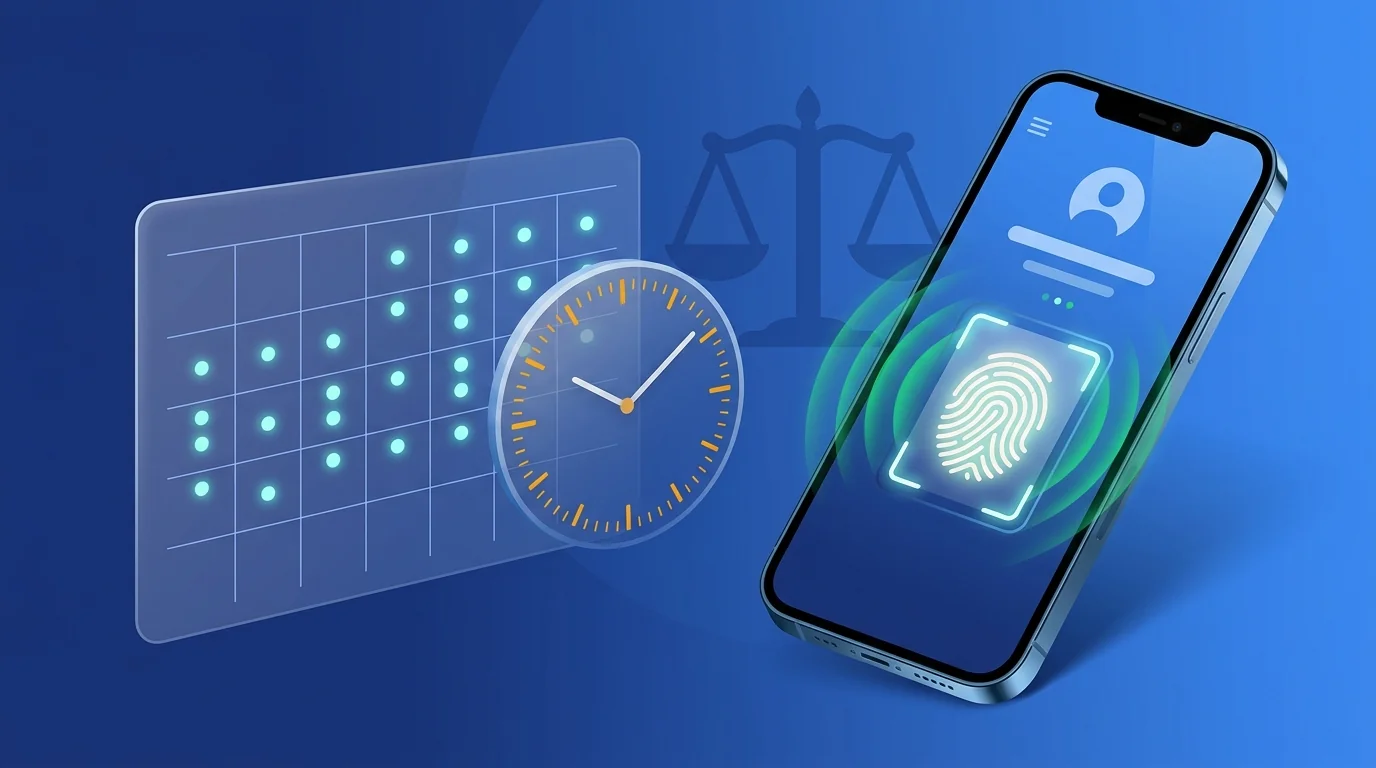
As of April 29, 2026, the starting point remains the daily working-day record under article 34.9 of Spain's Workers' Statute: start and end time, documented organisation, retention of records and availability to employees, employee representatives and the Labour Inspectorate.
Digital clock-in is a useful practice when it improves traceability, access and incident control, but it is important to separate what is already mandatory from what may still be under regulatory discussion.
Key points to review from the start
The priority is for records to be reliable, accessible and aligned with how teams actually work.
- Record the start and end of each working day while preserving permitted working-time flexibility.
- Keep records for four years and make them available for consultation or inspection.
- Cover remote work, flexible hours, incidents and approvals with a clear internal policy.
Official sources to review
Before updating policies or communicating mandatory changes, validate the current text in official sources.
- Workers' Statute, article 34, covering working time and daily records.
- Working-day record guide from Spain's Labour and Social Security Inspectorate.
How to bring it into operations without friction
To adapt well, the company needs to combine technology, procedure and training.
- Review how teams clock in today and which exceptions are not properly covered.
- Update internal policies for flexible hours, remote work and right to disconnect.
- Verify that the system offers traceability and reporting useful for audit.
Where Dokuflex fits in
Dokuflex helps turn these requirements into processes for recording, reviewing, handling incidents and maintaining evidence connected with HR.
- Lower operational risk from inconsistent processes.
- More visibility over working-day incidents and exception rules.
- Smoother adoption in on-site and hybrid environments.
Turn this need into a measurable process
Dokuflex combines BPM Low-Code, document management, digital signature, integrations and AI to help you automate processes with control, traceability and the ability to evolve.
Frequently asked questions
Does the working-day record also affect remote work?
Yes. Remote and hybrid environments should be covered by a system able to record start and end times with reliability and traceability.
Is digital clock-in already mandatory in Spain in 2026?
The current obligation is to keep a daily working-day record and retain it for four years. Before treating new digital requirements as mandatory, verify official BOE publication and consult labour counsel.
Is clocking in on an app enough?
Not always. The key is that the record is reliable, accessible, retainable and backed by consistent internal processes and policies.
Related articles
View all
A time-tracking system that makes a difference
What a time-tracking system should offer to comply with the law, adapt to hybrid work and provide real visibility to the company.

How to implement BPM Low-Code with AI in your company without complicating operations
Practical guide to launching a BPM Low-Code with AI project with focus, realistic scope and measurable results from phase one.
7 advantages of BPM Low-Code with AI for companies that want to automate better
Summary of the most tangible benefits of BPM Low-Code with AI when the company aims to automate with more speed, control and adaptability.