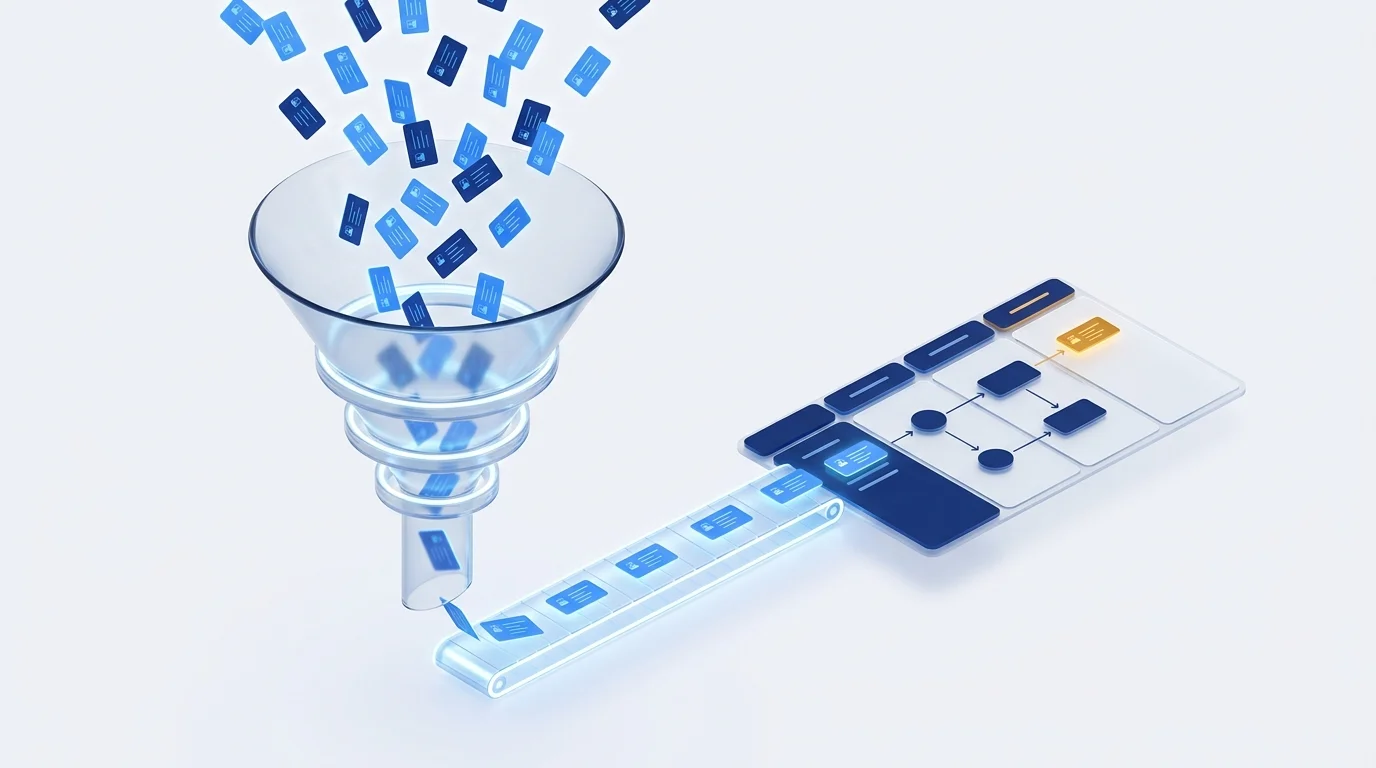
The problem: leads are not lost at capture, they are lost afterwards
Most B2B teams obsessively measure cost per lead and barely measure what happens next: how long a rep takes to make contact, how many leads never get a reply, and how many go cold in the handoff between marketing and sales. That is exactly where the money disappears.
The symptoms repeat across almost every organisation we analyse:
- Response times of hours or days. The lead arrives at night, at the weekend or while the rep is on a visit, and nobody touches it until "whenever possible". Meanwhile buyer interest plummets: the market trend is clear that whoever responds within the first minutes multiplies their chances of opening a conversation compared with whoever takes a day.
- Manual handoffs between marketing and sales. The lead travels in an email, a spreadsheet or a chat message. No clear owner, no deadline, no record of whether anyone acted.
- Inconsistent qualification. Each rep decides by their own criteria which lead is "worth it". Disqualifications go undocumented and nobody learns from them.
- Follow-up that depends on memory. The "I'll call you next week" lives in each person's head. If that person gets overloaded or leaves, the lead vanishes.
- Zero visibility of the real funnel. Leadership sees the leads coming in and the contracts signed, but not where everything in between leaks out.
None of this is fixed by hiring more reps or buying more traffic. It is fixed by treating the funnel as what it is: an end-to-end business process with stages, owners, deadlines and data. In other words, natural territory for low-code BPM.
What a lead funnel automated with BPM and AI looks like
An automated funnel is the same journey you run today — capture, qualify, assign, follow up, close — but modelled as an executable workflow: every lead enters a process with rules, and the process does not let it sit still. These are the seven stages:
- 1 · Multichannel capture: web forms, landing pages, campaigns, trade shows or inbound email. Each entry creates a process instance instantly, with no manual re-keying.
- 2 · Validation and enrichment: the process checks that the email and phone are real, deduplicates against your base and enriches the record with company data (industry, size, location).
- 3 · AI lead scoring: Dokuflex AI scores the fit (profile, behaviour, intent) and recommends the next step. The rule is traced: you know why a lead is A, B or C.
- 4 · Routing to the rep: the hot lead goes straight to the right person by territory, industry or workload, with the task already created and all the context inside.
- 5 · SLAs and escalations: if the lead is not contacted within the defined window — 15 minutes, 1 hour, whatever you decide — the process notifies, reassigns or escalates to the manager. The lead is never orphaned.
- 6 · Automated nurturing: leads that are not ready yet enter content sequences by industry and interest, with reactivation signals that bring them back into the sales loop at the right moment.
- 7 · Close and handover to onboarding: on signing, the full file — data, documents, terms — transfers automatically to the customer onboarding process. Nothing re-keyed, nothing promised in the sale gets lost.
The difference versus a simple connector between tools is governance: BPM brings owners, deadlines, escalations and an auditable record of every step. To go deeper into the fundamentals, see our guide to workflow automation.
2026-2028 outlook: the funnel stops waiting for people
What is a competitive edge today will be the minimum bar in two years. Three trends set the direction:
AI agents that qualify and book on their own
The agent talks with the lead the moment it arrives — web, email or WhatsApp — answers questions, completes qualification and books the meeting straight into the right rep's calendar. The first sales interaction no longer waits for someone to be free.
Hyper-personalisation by industry and role
Nurturing content, the case studies shown and even the initial proposal are generated dynamically based on the lead's industry, role and behaviour. The generic follow-up email becomes obsolete.
Speed-to-lead <5 minutes as the standard
Responding to a lead in under five minutes will stop being a differentiator and become what the buyer takes for granted. Whoever still replies in 24 hours will compete against companies that already talked, qualified and booked.
Autonomy with governance, not at any price
An agent that promises prices or discounts without control is a risk, not an improvement. That is why agents live inside the BPM: they act on scoped tasks, leave an auditable trail, and sensitive decisions — pricing, terms, disqualification — go through a person.
The practical conclusion: you do not need to wait until 2028 for any of this, but you do need the process foundation. An AI agent on top of a chaotic funnel only accelerates the chaos; on top of a BPM-modelled funnel, it multiplies the team's capacity without losing control.
Manual vs automated funnel: the honest comparison
This is how each stage changes when the lead journey stops depending on emails and spreadsheets:
| Stage | Manual funnel | Funnel automated with BPM and AI |
|---|---|---|
| Response time | Hours or days; depends on who checks the inbox. | Minutes, with a measured SLA and automatic escalation if nobody acts. |
| Assignment | Email or chat: "can anyone take this one?" | Routing by territory, industry and workload, with the task already created. |
| Qualification | Each rep's individual judgement; undocumented disqualifications. | Consistent, traced AI scoring; disqualifications record their reason. |
| Follow-up | Lives in each person's memory and calendar. | Reminders, retries and escalations the process runs on its own. |
| Nurturing | Non-existent, or one generic newsletter for everyone. | Sequences by industry and interest with behaviour-based reactivation. |
| Visibility | Nobody knows at which stage leads leak out. | Conversion and cycle times per stage on a live dashboard. |
| Handover to onboarding | Information is re-keyed; what was agreed in the sale gets lost. | The full file transfers to the onboarding process with no re-capture. |
How much is that difference worth in your case? Put numbers on it with the Dokuflex ROI calculator: hours of manual handling, unanswered leads and the cost of each lost opportunity.
How to build it in Dokuflex, step by step
You do not need a six-month project. With the low-code designer, the first operational funnel stands up in days:
- Model the journey as a process. Draw your funnel's real stages in the BPM designer of Dokuflex low-code BPM: capture, qualification, assignment, follow-up, close. What is not drawn cannot be measured.
- Connect the capture. Web forms, landings and inbound email create instances automatically. If you already have a CRM, Dokuflex integrates with it: the CRM stays the system of record; the BPM is the engine that pushes.
- Add validation and enrichment. Deduplication rules and company data filled in automatically, so the rep never receives a half-baked lead.
- Configure scoring and routing. Define your ideal customer criteria and assignment rules with Dokuflex AI. Start simple — A/B/C and two routes — and refine with data.
- Activate SLAs and escalations. Decide the maximum first-contact window and what happens if it is breached: reminder, reassignment or alert to the manager. This is where the leaks get sealed.
- Measure and improve monthly. The dashboard gives you conversion and cycle times per stage. Use the Dokuflex process templates to extend the flow into onboarding, signature or invoicing without starting from scratch.
The mechanics are proven at scale: CaixaBank manages 4.2 million contracts a year on Dokuflex processes, Hospital Sant Pau saves 12,000 hours a year and Mutua Terrassa has digitised more than 250 processes. The same engine that sustains those volumes is the one routing your leads.
Frequently asked questions
What is lead funnel automation with BPM? +
It means modelling the entire lead journey — capture from forms or the web, data validation and enrichment, lead scoring, routing to the right rep, SLAs, nurturing and handover to onboarding — as an executable BPM process. Every lead enters a flow with defined owners, deadlines and escalations, so none goes unanswered or gets lost between marketing and sales.
Why does lead response time (speed-to-lead) matter so much? +
Because B2B buyer interest drops fast after they submit their details: the market trend is clear that whoever makes contact within the first minutes multiplies their chances of opening a conversation compared with whoever takes hours or days. That is why, between 2026 and 2028, speed-to-lead under 5 minutes is becoming the standard — and it is only consistently achievable with an automated funnel with SLAs and escalations.
How does AI lead scoring work inside a BPM? +
The AI evaluates each lead using the captured and enriched data — industry, company size, role, website behaviour, fit with your ideal customer — and assigns a score and a next-step recommendation. The BPM uses that score to route: hot leads go straight to the right rep with a short SLA, warm leads enter nurturing, and disqualified ones are recorded with their reason. The decision is fully traced and a person can supervise or correct it.
What happens to leads that are not ready to buy yet? +
They are not discarded: they enter an automated nurturing loop. The process sends them relevant content based on their industry and interest, monitors activity signals (visits, downloads, replies) and, when behaviour indicates buying intent, reactivates them and routes them back to the rep with the full history. The funnel recovers sales that manual follow-up would let go cold.
Do I need to replace my CRM to automate the funnel with BPM? +
No. BPM does not replace the CRM: it orchestrates it. Dokuflex integrates with your CRM, your website, your email and your ERP, and adds the process layer the CRM lacks: SLAs with escalations, validations, AI scoring, tasks with an owner and end-to-end traceability. The CRM remains the sales system of record; the BPM guarantees that every lead moves forward.
How do I start automating my lead funnel in Dokuflex? +
Start with a 60-minute guided session: we map your current funnel, locate the leaks (response time, manual handoffs, leads without follow-up) and build a first process with capture, scoring and routing using Dokuflex's low-code designer and templates. Most teams ship the first version in days, not months, and refine it with per-stage conversion data.
Seal your funnel's leaks before your competitors do
We book a 60-minute guided session to map your lead journey, measure where it leaks and build a first flow with capture, AI scoring, routing and SLAs on Dokuflex.