🏦Banking · Case study
4.2 million contracts digitally signed in the first year
CaixaBank
·
Published Oct 2025
·
8 min read
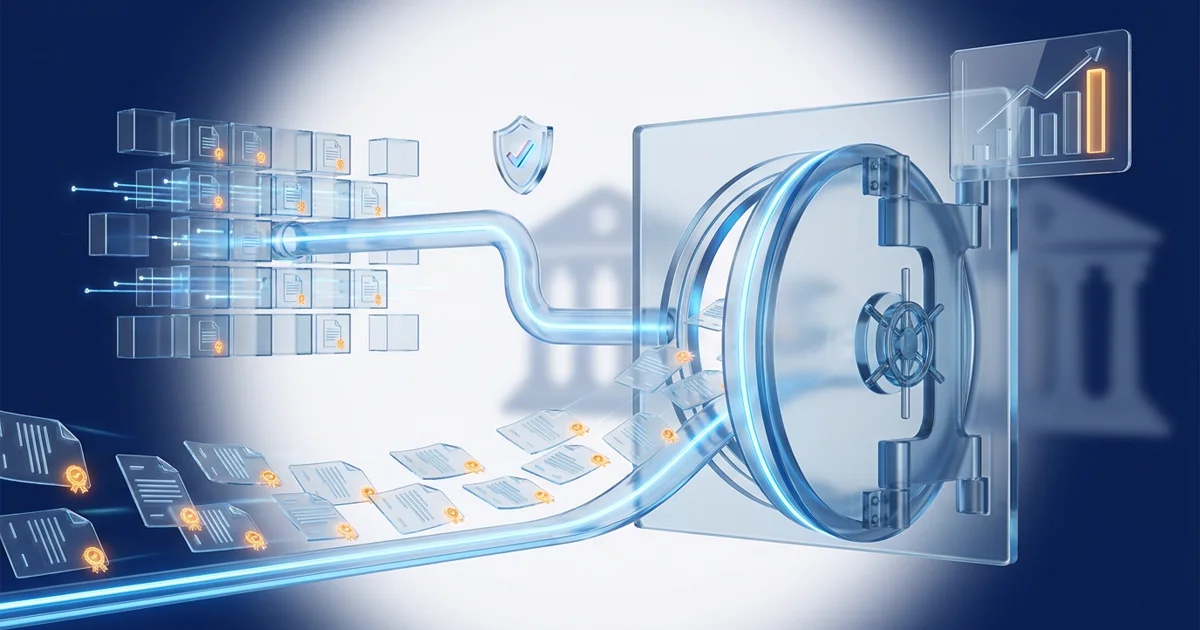
A tier-one bank contracts at industrial scale: account openings, card issuance, mortgages, consumer loans and insurance policies, each with its own contracting journey. Historically, every product line had solved signing on its own — different vendors, different legal evidence, different archives. The result was the classic banking pattern: inconsistent signing experiences across channels and a growing audit cost, because proving the integrity of a contract meant reconstructing the evidence chain across separate systems.
CaixaBank needed a single digital signature layer serving every product, embedded in its own channels (mobile app, branch, remote advisor), integrated with the banking core and carrying full eIDAS advanced and qualified validity depending on the type of operation.
The non-negotiables: banking-grade availability (you cannot "stop signing" for a single minute), latency imperceptible to the end customer, a complete legal evidence trail for every signature (who, what, when, from where, with which method) and long-term archiving with qualified timestamping.
Dokuflex was deployed as a cross-product signature platform across two active-active regions: if one region degrades, the other absorbs the traffic with no service interruption. On that foundation, signing is exposed to the bank's channels in two ways: as an API for back-office processes, and as a native iOS/Android SDK embedded in the CaixaBankNow app, so the customer signs without ever leaving the bank's application — no redirects, no third-party apps.
Every operation produces its evidence file: signer identity verified against the core, document fingerprint, geolocation and device, signing method used and qualified TSA timestamping. The evidence file is archived with long-term integrity guarantees, ready for expert testimony or a regulator's request.
4.2 million contracts digitally signed in the first year of full rollout — roughly 16,000 contracts every working day, sustained at 99.99% availability thanks to the multi-region architecture. For the end customer, signing completes in under 1.8 seconds on average: in experience terms, signing is just another gesture inside the app, not a procedure.
For the bank, the structural change is the unification of legal evidence: every product signs against the same layer, with the same evidence-file format and the same archive. An audit that used to require consolidating several systems is now answered from a single point of inquiry.
The pattern is replicable in any financial institution: the combination of eIDAS signing, embedded SDK and process orchestration is the same we apply in banking and financial services and in insurance.
One product and one channel in month 3, with success metrics defined, before generalising. The app went live in month 4; rollout to all products ran from months 5 to 12.
Keeping the customer inside the bank's own app — no redirects to third-party domains — removes the classic drop-off point of digital contracting journeys.
The evidence-file format was agreed with legal counsel and internal audit before the first real contract was signed — not after.
In banking, the signing layer is critical infrastructure: the two-region active-active design was decided in the architecture phase (months 1-2), not as a later improvement.
Every banking product signs against the same layer: the customer signs inside the bank's own app, and the legal evidence lands in a single evidence-file format.
4.2 M contracts a year, 99.99 % uptime and advanced and qualified eIDAS signing in under 1.8 s on average.