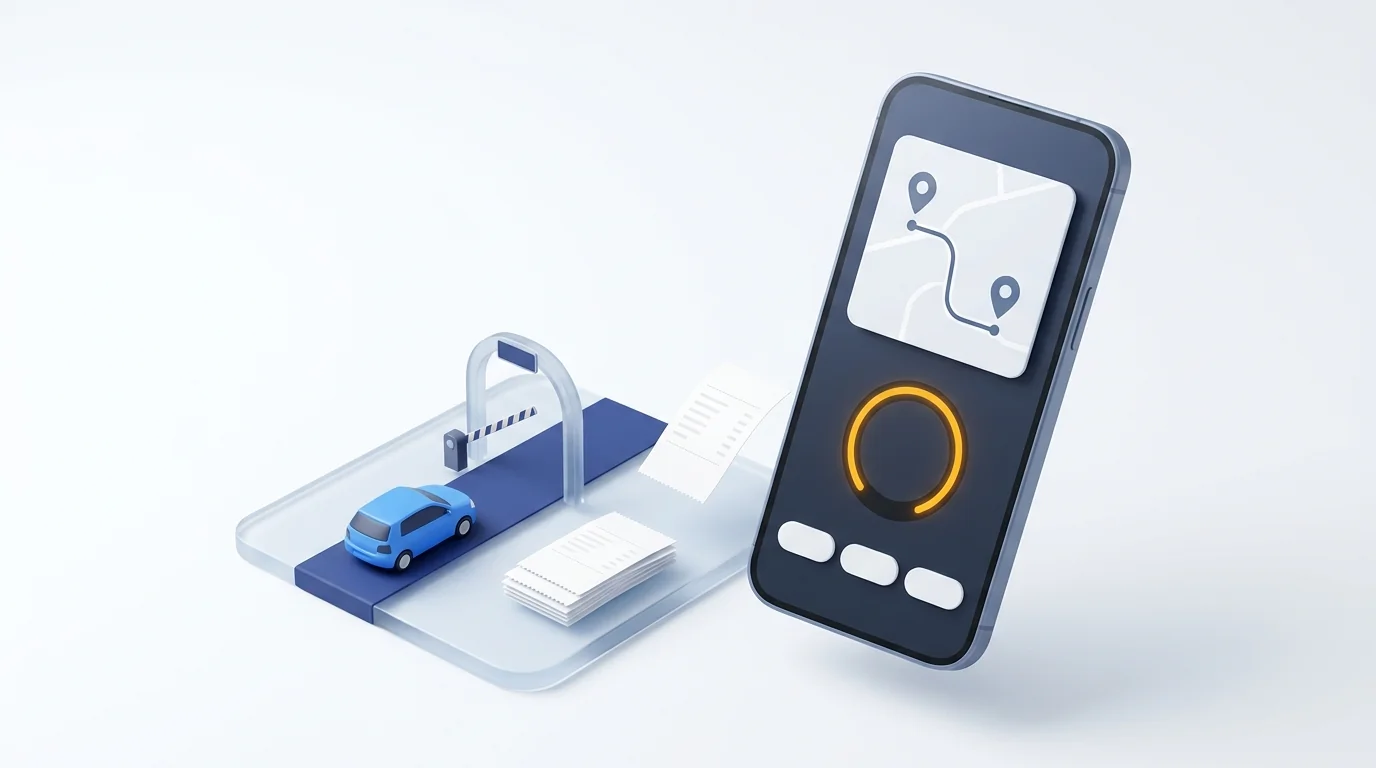
The tax-free mileage allowance in Spain for 2026 is €0.26 per km in the employee's own vehicle, set by Order HFP/792/2023 in article 9 of the IRPF Regulation and not updated as of 15 September 2026, plus documented tolls and parking. Whatever the employer pays above that is taxed and subject to social security as salary.
What is the mileage rate in Spain in 2026?
€0.26 per kilometre driven, if we mean the amount the tax authority leaves out of personal income tax (IRPF). It is set in article 9.A.2.b) of the IRPF Regulation since Order HFP/792/2023 of 12 July raised it from the €0.19/km frozen since 2005. As of 15 September 2026 no later order changing that amount has been published in the BOE: 2026 is paid at the same rate as 2024 and 2025.
Two questions that usually get mixed up should be kept apart. One is how much is exempt: €0.26/km, decided by tax law. The other is how much the employer has to pay: whatever the collective agreement, the contract or the internal expense policy says, which may be €0.26, more or less. The IRPF law does not oblige anyone to pay anything; it only says up to what point the payment is not salary.
The exemption covers use of the employee's private vehicle to travel «away from the factory, workshop, office or workplace to perform the job somewhere else». There is no annual cap or kilometre limit; what it requires is that each trip be real and documented. It does not distinguish by engine size, fuel or age of the car: €0.26 is the same for a compact and for an EV.
Spain mileage table 2026: what is exempt and what is paid on top
The amounts in force, with the rule they come from. The right-hand column is the one that settles arguments with the payroll provider.
| Item | Exempt amount 2026 | Condition | Rule |
|---|---|---|---|
| Mileage in the employee's own vehicle (private-sector employee) | €0.26/km | Trip away from the workplace to work somewhere else; the trip is documented. | Art. 9.A.2.b) IRPF Regulation · Order HFP/792/2023 |
| Tolls and parking | 100% of the cost | Added on top of the €0.26/km; exempt only with a receipt or invoice. | Art. 9.A.2.b) IRPF Regulation |
| Public transport (train, plane, taxi, bus) | 100% of the cost | Documented with an invoice or equivalent. | Art. 9.A.2.a) IRPF Regulation |
| Compensation for use of a private vehicle (public-sector staff) | €0.26/km car · €0.106/km motorcycle | Authorised official travel; same tax exemption as everyone else. | Art. 18.1 RD 462/2002 · Order HFP/793/2023 |
| Excess over €0.26/km | €0 exempt | Employment income: IRPF withholding and social security contributions. | Art. 9.A.6 IRPF Regulation · Art. 147.2 LGSS |
| Commute home ↔ usual workplace | €0 exempt | Not a trip «to work somewhere else»; if paid, it is salary. | Art. 9.A.2 IRPF Regulation |
Amounts in force on 15 September 2026. Check the latest consolidated text in the BOE before applying them.
Spain mileage calculator 2026: exempt, excess and total to pay
Enter the kilometres, what your company pays per kilometre and the tolls or parking for the period. The calculator separates what goes tax-free from what lands on the payslip. It runs in your browser: no data is sent and no email is asked for.
Exempt limit applied: €0.26/km (art. 9.A.2.b IRPF Regulation, Order HFP/792/2023). The excess carries IRPF withholding on the payslip and social security contributions.
Is mileage taxed and subject to social security? Only what exceeds €0.26/km
Up to €0.26/km, neither taxed nor subject to contributions. Above it, both. The tax rule and the social security rule go together because the second refers to the first:
- IRPF (personal income tax). Article 17.1.d) of the IRPF Law lists among employment income «per diems and travel allowances, except travel costs and normal meal and lodging costs [...] within the limits set by regulation». Article 9.A.6 of the Regulation closes the loop: whatever exceeds those limits «shall be subject to tax». In practice, the employer applies withholding on the excess on the payslip, includes it in the quarterly form 111 and the annual form 190, and the employee sees it on their withholding certificate.
- Social security. Article 147.2 of the General Social Security Law (LGSS) excludes from the contribution base travel allowances for employees who travel away from their usual workplace «in the amount and with the scope provided in the state IRPF rules». That is exactly €0.26/km plus documented tolls and parking. Article 23 of the General Regulation on Contributions (RD 2064/1995) develops the same rule: the excess is counted in the base, with employer and employee contributions.
Two consequences HR tends to forget. First: the excess does not cancel the exempt part. Paying €0.30/km does not turn the whole €0.30 into salary; only the €0.04. Second: the exempt part still has to be reported, even though it carries no withholding: in form 190 it goes under key L (exempt income), sub-key 01, so the tax authority can match it with what the employee declares.
And a third, on the employee's side: the exempt €0.26/km does not appear as income in their tax return. Only the excess does, and that already shows on the withholding certificate as employment income.
Worked examples: five payment policies and what lands on the payslip
Same employee, 800 km a month, five ways of paying them. The table shows what they receive, what is exempt and what is taxed and subject to contributions.
| Company policy | Employee receives | Exempt | Taxed and subject to contributions |
|---|---|---|---|
| €0.26/km (exact limit) | 800 × 0.26 = €208.00 | €208.00 | €0.00 |
| €0.26/km + €38.50 tolls and €12 parking with receipts | 208.00 + 50.50 = €258.50 | €258.50 | €0.00 |
| €0.32/km set by the collective agreement | 800 × 0.32 = €256.00 | €208.00 | €48.00 (800 × 0.06) |
| €0.40/km «to cover wear and tear» + €38.50 tolls without receipts | 320.00 + 38.50 = €358.50 | €208.00 | €150.50 (112.00 excess + 38.50 undocumented) |
| €0.19/km (policy not updated since 2023) | 800 × 0.19 = €152.00 | €152.00 | €0.00 — but the employee loses €56 of exemption they cannot recover in their tax return |
The row that surprises most is the fourth: the €38.50 of tolls that were clean in the second row end up on the payslip for lack of a receipt. Same money, same trip; what changes is the supporting document.
Tolls and parking: on top, at 100% and only with a receipt
Tolls and parking are not inside the €0.26/km: article 9.A.2.b) itself adds them expressly («plus toll and parking costs that are documented»). They are reimbursed at their actual cost, also tax-free, under three conditions:
- A receipt. Toll ticket, parking receipt or invoice. Electronic toll tags or parking apps are fine if they generate a receipt with date, amount and place; a card statement on its own is weak evidence.
- A link to the trip. The toll has to match the route and date on the travel record: an AP-7 motorway ticket on a trip declared as Madrid–Valladolid will not pass.
- Actual cost, not an estimate. A monthly «toll allowance» with no tickets is not acceptable: that is salary.
What is included in the €0.26/km and cannot be paid separately without being taxed: fuel, wear, insurance, maintenance and tyres of the employee's vehicle. Reimbursing fuel receipts for a private car on top of mileage compensates the same cost twice; the second payment is employment income. And fines are never a travel cost.
Civil servants and private employees: same figure, different rules
Since July 2023 both stand at €0.26/km, but they get there by two routes that should not be confused in a public-sector payroll or in a company that also has staff on official travel.
| Private-sector employee | Public-sector staff (RD 462/2002) | |
|---|---|---|
| What the figure regulates | How much is exempt from IRPF. How much is paid is set by the collective agreement, the contract or the expense policy. | How much is paid as compensation for official travel: €0.26/km by car and €0.106/km by motorcycle (art. 18.1 RD 462/2002, updated by Order HFP/793/2023). |
| Prerequisite | Trip away from the workplace to work somewhere else, documented by the employer. | Authorised official travel and use of a private vehicle authorised by the competent body. |
| Tax treatment | Exempt up to €0.26/km + documented tolls and parking; the excess is taxed and subject to contributions. | The same: the article 9 exemption applies equally to public and private employment income. |
| If the agreement or regional rule sets another amount | The agreement's rate is paid; the exemption stays at €0.26. | Regional and local governments may have their own travel-compensation rules; the tax exemption does not change. |
Self-employed workers are outside all of this: they do not receive employment income and deduct vehicle costs through a different route (allocation to the business activity), with its own rules and limits. This article is for anyone paying mileage to people on payroll.
How to document mileage: the travel record that survives a tax check
The burden of proof lies with the employer, who is the one not withholding. The Regulation asks that «the reality of the trip be documented»; it does not say how, so the standard has been set by AEAT practice and the courts: one record per trip with these details, approved by a manager and kept on file.
| Field | What it proves to the tax authority | How to capture it without friction |
|---|---|---|
| Date and time | Places the trip on a working day and cross-checks it with the time record. | Automatic when the expense is created from the phone. |
| Business purpose | Customer visited, site, meeting, training. It is what turns the trip into «work somewhere else». | Mandatory field, ideally linked to the customer or project in the CRM. |
| Origin and destination | Shows the trip starts at the workplace (or at home, when going straight to the customer) and is not the usual commute. | Addresses on the map; the distance is calculated by the mapping service. |
| Kilometres | Basis of the calculation. The tax authority compares it with the reasonable distance between the two points. | Distance from official map data, return trip; the employee adjusts if there was a justified detour. |
| Vehicle and plate | Shows it is a private vehicle and not a company car (which generates no mileage). | Stored once in the employee's profile. |
| Attached receipts | Tolls and parking, which are not exempt without a ticket. | Photo of the receipt with OCR; certified digitisation lets you discard the paper. |
Three clarifications that save trouble. No fuel receipt is needed: €0.26/km is a flat amount and a petrol receipt neither adds nor subtracts. No specific app or Google Maps is required: any reasonable, repeatable distance calculation is fine. And the documentation is kept for at least four years, the limitation period under article 66 of the General Tax Law; if receipts are kept digitally, doing it with AEAT-homologated certified digitisation lets you destroy the paper without losing evidential value.
What does not hold up: a fixed monthly amount «for mileage» with no records, identical round kilometres every month, or records filled in at the end of the quarter. There the AEAT reclassifies everything as salary, with unpaid withholding, surcharges and interest.
Collective agreements that set rates above €0.26/km
If the collective agreement sets a higher per-kilometre rate, the employer must pay it, and even so only €0.26/km is exempt. The two rules do not clash: the agreement governs the employment relationship and says how much is paid; the tax rule governs the tax and says how much is not salary. The fact that the amount is imposed by the agreement does not make it exempt.
What payroll has to do when the agreement sets, for example, €0.32/km:
- Pay the full €0.32/km: it cannot be reduced to the exempt amount by invoking tax rules.
- Split the payslip into two items: exempt mileage (0.26 × km) and taxable mileage (0.06 × km), the latter with withholding and contributions.
- Report both in form 190: the exempt part under key L.01 and the taxable part as ordinary employment income.
- Review the agreement every year: many update the rate with inflation or at each renewal, and the company's expense policy has to follow.
The opposite case also exists: agreements that still set €0.19/km or other pre-2023 figures. There the employer complies with the agreement by paying €0.19, but can pay up to €0.26 with no tax or contribution cost, and it is usually the cheapest improvement you can offer a travelling team.
Common mistakes when paying mileage (and what each one costs)
The ones that come up again and again in payroll reviews and AEAT information requests:
| Mistake | Consequence | How to avoid it |
|---|---|---|
| Still paying €0.19/km | The employee loses €0.07/km of exemption they cannot recover; the company pays less than it could at no tax cost. | Update the expense policy to €0.26/km and set the rate as a parameter, not a number typed on each record. |
| Paying more than €0.26/km without withholding on the excess | Unpaid withholding, unpaid contributions, surcharges and interest; the AEAT regularises the four non-prescribed years. | Two payslip items: exempt and taxable. Let the software split them automatically. |
| Fixed monthly mileage with no records | Full reclassification as salary: there is no «reality of the trip» to document. | One approved record per trip with origin, destination, purpose and km. |
| Paying the home–office commute | It is salary: taxed and subject to contributions. Not a trip «to work somewhere else». | Only trips to customers, sites or other centres. Leaving home straight to the customer does count. |
| Reimbursing fuel on top of mileage | Double compensation: fuel receipts for a private vehicle are taxed. | Fuel only for company vehicles; private ones at €0.26/km. |
| Tolls and parking without a receipt | They lose the exemption and go on the payslip. | Photo of the receipt on the spot; OCR reads amount and date and attaches it to the record. |
| Not reporting exempt mileage in form 190 | Mismatches between what the company reports and what the employee has on file; information requests. | Key L, sub-key 01, with the exempt amount paid to each recipient. |
None of these is a hard question of interpretation; almost all are process failures: the data is not captured at the time, nobody approves it, and at month-end someone fills in a spreadsheet from memory.
How Dokuflex solves it: the route is picked on the phone and payroll receives two figures
The Dokuflex expense management module — part of Dokuflex, the AI low-code BPM platform — is built for teams that travel and for the department that later has to defend every euro before the tax authority. What it brings to the problem in this article:
- Origin and destination from the app. The employee picks the route on the phone and Dokuflex calculates the distance against official map data, with no kilometres typed in or argued over later.
- Current rate applied automatically. The tables from article 9 of the IRPF Regulation and the latest Ministerial Order are maintained in the platform; exempt mileage is assigned at €0.26/km without manual entry, and updates apply to every open payroll.
- Tolls and parking with one photo. AI OCR reads the receipt, thermal paper included, and attaches it to the trip; certified digitisation, homologated by the AEAT under the product name Doku4Invoices, lets you destroy the paper and keep the image with full legal validity.
- An expense policy that filters before approval. Limits by category, employee, cost centre or project: whatever does not comply never reaches the approver. The manager approves from the phone with a single gesture.
- SEPA reimbursement and accounting entry. Once approved, the payment goes to the employee's account and accounting receives the entry, with the expense and its receipt linked.
The same flow covers the meal and lodging per diems of the same trip and sits alongside the other HR processes, such as paid leave requests, with their document trail in each person's file.
Frequently asked questions
What is the mileage rate in Spain in 2026? +
The IRPF-exempt amount is €0.26 per kilometre driven in the employee's own vehicle, set by Order HFP/792/2023 in article 9 of the IRPF Regulation. As of 15 September 2026 no later order updating it has been published in the Official Gazette (BOE), so €0.26/km remains the reference. Tolls and parking documented with a receipt or invoice are added on top. The employer may pay more, but the excess is taxed and subject to social security.
Is mileage taxed and subject to social security contributions in Spain? +
Up to €0.26/km it is neither taxed under IRPF nor included in the social security contribution base, provided the trip is documented (article 9 of the IRPF Regulation and article 147.2 of the General Social Security Law). Anything the employer pays above that amount is employment income: IRPF withholding is applied on the payslip, it is reported in forms 111 and 190 and it enters the contribution base, with both employer and employee contributions.
Are tolls and parking included in the €0.26 per km? +
No. The €0.26/km covers the use of the vehicle (fuel, wear, insurance, maintenance). Tolls and parking are reimbursed separately, at 100% of their cost and also tax-free, as long as they are documented with the receipt or invoice and linked to the business trip. Without a receipt, the reimbursement becomes employment income.
What happens if the employer pays more than €0.26 per kilometre? +
The part up to €0.26/km stays exempt; only the excess is taxed and subject to contributions. For example, at €0.32/km for 800 km a month, €208 is exempt and €48 (0.06 × 800) is salary: the employer withholds IRPF on those €48, pays contributions on them and reports them in forms 111 and 190. If the higher rate is set by the collective agreement, the employer must pay it, but the tax exemption does not change.
What if the employer pays less than €0.26 per km? +
It may, unless the collective agreement or the contract sets a minimum, but the employee cannot deduct the difference up to €0.26/km in their own tax return. The exemption is a scheme between employer and employee: if the employer does not use it in full, that part is simply lost. The sensible move is to update the expense policy to €0.26/km, which remains a deductible expense for the company.
How do you document mileage for the Spanish tax authority? +
The employer, who applies the exemption, must be able to prove the trip took place: date, business purpose, origin and destination, kilometres driven and vehicle used, in an approved travel record or expense claim consistent with the diary or visit plan. No fuel receipt or specific app is required; a distance calculated with mapping or GPS is fine. The documentation is kept for at least four years, the limitation period under article 66 of the General Tax Law.
Can the commute from home to work be paid as tax-free mileage? +
No. The exemption covers trips away from the factory, workshop, office or workplace to perform the job somewhere else (article 9.A.2 of the IRPF Regulation). The usual commute between home and the workplace does not meet that condition: if the employer compensates it, the amount is salary, taxed and subject to contributions. A trip from the workplace, or directly from home, to a customer's premises, a construction site or another centre does qualify.
Sources
- Order HFP/792/2023 of 12 July (in Spanish), revising the amounts of per diems and travel allowances in the IRPF: sets €0.26/km in articles 9.A.2.b) and 9.B.1.a) of the Regulation.
- IRPF Regulation (Real Decreto 439/2007, consolidated text, in Spanish): article 9.A.2 (travel costs: documented public transport and €0.26/km plus tolls and parking) and 9.A.6 (taxation of the excess).
- Law 35/2006 on IRPF (in Spanish): article 17.1.d), per diems and travel allowances as employment income.
- General Social Security Law (Real Decreto Legislativo 8/2015, in Spanish): article 147.2.a) and b), travel allowances excluded from the contribution base in the amount and with the scope of the IRPF rules.
- General Regulation on Social Security Contributions (Real Decreto 2064/1995, in Spanish): article 23, items included and excluded from the contribution base.
- Order HFP/793/2023 of 12 July (in Spanish), compensation for use of a private vehicle on official travel: €0.26/km by car and €0.106/km by motorcycle.
- Real Decreto 462/2002 of 24 May (in Spanish), on compensation for official travel: article 18.
- AEAT e-office — IRPF: forms 111 and 190 and practical manuals.
Every kilometre reaches payroll already split into exempt and taxable
Route from the phone, distance from official map data, €0.26/km applied, tolls with a photo of the receipt and SEPA reimbursement. Set up your expense policy today and the team logs trips tomorrow. Start free, no card required.